







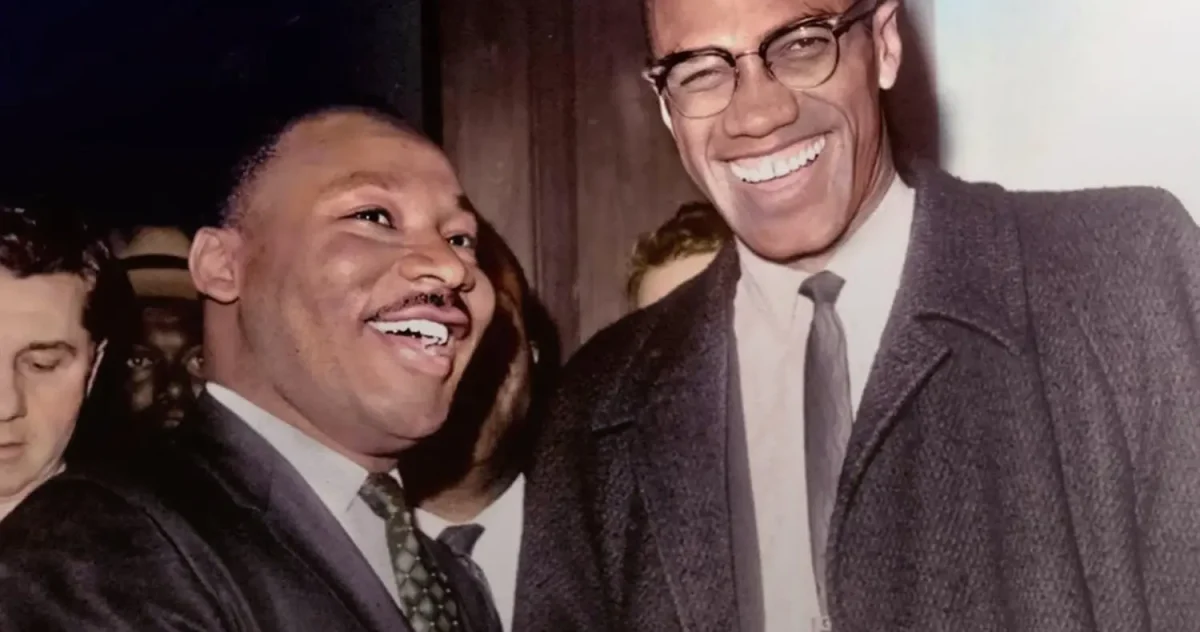





















APB journalists debated for weeks on who was more effective during the civil rights movement. And here is what we had to say about it: Even though Martin Luther King Jr’s popularity built a community, this community does not compare to the authenticity of Malcolm’s representation for his people. Apb journalists wonder if Mlk’s speeches and rhetoric choices made a bigger change within his community in comparison to Malcolm X. We bring reason to assert Malcolm X as superior. Due to Malcolm’s ability to resonate with his community. Malcolm X manages to gather his audience with his complex use of allusion. Malcolm X manages to use allusion and additional rhetoric choices to put the people in the shoes of the oppressed. He emphasizes the absurdity of the societal norms placed upon his people at the time. Malcolm takes a stance to face the oppressor head on to show that the muzzle on the dog doesn’t stop it from barking. Attacking oppression at the source allows people to feel powerful even while being oppressed . Malcolm X uses people’s bottled up emotion and uses it as a molotov to make his people feel heard, seen, and felt within his community. Malcolm X emphasises that change comes with action and emphasizes the need for change comes with greatness. For this reason I say Malcolm X to be far superior in the fight for civil rights due to his ability to magnify the needs for his people and serve his community in times of need.
During the civil rights movement millions of black Americans were outraged with the unrightful political injustice that their community has faced. This upbringing of unrightful justice brought history a lesson to not stand for injustice as malcolm x and martin uther king jr both fought and risked their lives for the rights of black Americans across the country. While malcom x was raised in the the mist of injustice personally experiencing it for himself martin luther king was mainly shielded from violence with his Christian upbringing. As Martin Luther’s king father was a pastor in a christian church martin idolized his father christian beliefs and followed in his footsteps speaking against evil with Christian influence. Malcom stood for his own personal beliefs as Malcolm was raised in the midst of struggle often expressing hardship without a savoir someone to look up to in his community as everyone in and out only looked down as if a hopeless god let his people suffer. Malcolm takes a stance to speak up against the struggle for his people as malcom soon realised that noone is coming to save them Malcolm uses his struggle filled upbring to fuel his arguments against the injustice brought upon his community.Many people resonated with Malcolm’s struggle as it was relatable and authentic to Malcolm’s target audience being the exact same people he was raised with, his family and his people. People choose to follow Malcolm as his arguments were not filled with hope it was filled with certainty, certain to get the justice his people deserved.
Malcolm X believed that real change wouldn’t happen without action. That’s why he pushed for a more direct approach, especially as his community faced so much violence during the civil rights movement. Malcolm wanted people to confront the struggle head on and see that no one should have to deal with such harsh and unfair treatment. He talked about humanity and reason in a way that really hit home for people his message was relatable because so many could see themselves in it. Malcolm’s ability to reflect his people’s pain made a strong impression on those who read his work or heard him speak. Because he understood both his own struggles and those of others, he connected not just with his community but with humanity as a whole. In his writing and speeches, he made it clear that the struggle he described was something anyone could relate to. For example, in his speech “The Ballot or the Bullet,” he takes a stand on humanity’s suffering despite people’s differences, saying.
“You don’t catch hell because you’re a Baptist or a Methodist… You catch hell because you’re a Black man. You catch hell because you’re an American. You catch hell because you’re a victim of Americanism.”
(from his 1964 speech “The Ballot or the Bullet”), Malcolm X brings up religious differences like being Baptist, Methodist, or Muslim but then brushes them aside. By mentioning familiar Christian groups, he gets the attention of a religious crowd, but then shifts the focus to what everyone has in common: suffering. The way he repeats “You catch hell” sounds almost biblical, making the injustice feel universal and deeply personal. Malcolm makes it clear that it doesn’t matter what religion you are, no one deserves to suffer like that. He doesn’t speak just as a Christian, Muslim, or Baptist, but as a human being, arguing for basic rights and a sense of connection with everyone. His approach encourages people to question their suffering and take action. This works because Malcolm understood society so well he was able to relate to his people and get his message across powerfully.
Malcommx does not only manages to perceive a broad audience but he also manages to get the attention of his listeners nationwide with his use of imagery and repetitive structure to get people to wake up to the violence to realize they are losing a battle chose to fight as in his speech ballot of the bullet he uses his rhetorical skills to say
“If you stick a knife in my back nine inches and pull it out six inches, there’s no progress. If you pull it all the way out, that’s not progress. Progress is healing the wound that the blow made. And they haven’t even begun to pull the knife out.”
(from his 1964 speech “The Ballot or the Bullet”). malcom illustrates a depiction of violence Malcolm X compares injustice to a knife being stuck in someone’s back. This graphic image forces the audience to feel the pain rather than just think about injustice abstractly to show the absurdity of injustice and to show the true effect that it has on his people comparing it to the wound of a knife emphasizes on the need to prioritize change and healing within his community this use of imagery and repetitive structure works wonder to get people to realize the true severity of progress as he also redefines what progress means. By saying that even pulling the knife out completely isn’t progress, he pushes the audience to rethink commonly accepted ideas about gradual reformformation. This makes listeners question whether delayed justice should be truly celebrated if it means to carry a wound that should of never been there in the first place as he uses the image of plymouth rock symbolizing the Pilgrims and the traditional founding story of America stating
“We didn’t land on Plymouth Rock — the rock was landed on us.”
(from his 1964 speech “The Ballot or the Bullet”) Malcolm X reverses the heroic narrative. Instead of voluntary settlement and opportunity, he reframes the origin story as one of oppression imposed on Black people. Malcolm X gets the listener to question the simple idea of plymouth rock landing on his people . the simplicity of the imagery used in the quotes resonates with many Americans as The idea of a rock “landing on” people suggests crushing weight, violence, and burden .For Black audiences, it validates historical pain and injustice.For white audiences, it can provoke discomfort, reflection, or defensiveness. Leaving many of the audience to question their morality of the tales once told to them this quote is short, rhythmic, and easy to repeat.allowing the memory to fully implement and resonate with many. Malcolm manages to use historical allusion and inversion to make a metaphor to reframe identity and bring a strong emotionally charged argument that pulls ears and teaches people a lesson with a simple and effective sentence.
While Malcolm X was focused on justifying the need for movement within his community, Martin Luther King was busy preaching about love and unity. Martin had a different solution to the oppression within his community. Martin saw the attacks on his people as an open flame; he did not wish to fight fire with fire, he wished to extinguish the flame with the kind words of God. Martin upbring has brought him many philosophical views that overall held him back from truly achieving justice. martin addresses the action taking place in his community and preach asked the reader when and why
“You may well ask: ‘Why direct action? Why sit-ins, marches and so forth?’”
(letter from birmingham jail) martin luther king jr uses rhetorical questions to get the reader to question one’s purpose . Martin manages to put his people on the same page while simultaneously addressing the opposition concern on extreme action as Martin does not believe in violence to achieve his goals. Martin prioritizes constructive nonviolent tension to achieve his dream . While martins holds excel t understanding of his people he fails to understand his opponent failing to effectively create progress. Martin makes logical argument bring reasoning to the table to prove his movement isn’t reactive and won’t cause harm to those who have harmed. Martin’s faith hopes that a wolf would pity its prey but fails to realize that a wolf only follow the savage nature given to them by god.
Martin was aware of the inevitable struggle waiting upon his people, while being a baptist he held strong to his faith but reminded his people that faith itself won’t save them. Similarly to malcolm x Martin wants his people to take action to improve their living conditions. Martin takes a stance on faith arguing if faith will really be the means of finding peace. Martin repeatedly points out the contradiction in logical arguments saying
“A religion that professes to be concerned about the souls of men and is not concerned about the slums that damn them, the economic conditions that strangle them, and the social conditions that cripple them is a dry-as-dust religion.”
(excerpt from King, Martin Luther, Jr. Strength to Love. Harper & Row, 1963.)martin reminds people of the struggle they face.martin reminds reader faith true purpose. Martin reminds people if action is not taken that struggle would never dissipate. Martin reminds the reader the importance of having the right ideas he speaks with a purpose to teach. Martin’s way of convincing mainly targets a christian audience leaving many to feel alienated from his message.For many Martin was a safe way to stand for what’s right. Martin’s lighthearted logical arguments left people assured that peace will one day come . Hope was essential for Martin and his followers leaving many to question Martin’s effectiveness in the fight for civil rights.
While Martin Luther King jr manages to use repetitive structure, metaphoric language and ethos to get people to wake up to the injustice they faced it does not effectively compare to malcom x ability to use imagery ,allusion ,metaphoric, language, ethos, pathos and repetitive structure. Unlike Martin Luther King Malcolm does not just address the issue within his community, he illustrates them using words. malcom effectively educates people on the severity in the battle for civil rights. malcom x was aware of his people’s need for change he knew that his people needed to start moving forward instead of pointing out the obvious. Restating the experiences they lived would only leave them stagnant. Malcolm knew faith alone wouldn’t help he knew that to oppression you have to break the chains that tied them to oppression. While martin had similar arguments malcom x separated his people from the oppressor using his people’s bottled up emotion as a molotov to create an explosive movement fueled by the emotional burden their god had brought upon them. this action is what fueled many to move people were eager to fight for what’s right what they needed was a weapon to amplify their needs. Martin does not achieve this as Martin’s argument only manages to point out the obvious. martin luther king jr fails to address the realistic needs and wants of his people leading his movement to stay stagnant leaving many to credit Malcolm x as an effective leader leaving many to look up to malcom x. Due to his proper understanding and hands on approach to the civil rights movement.